The Real Cause of Delivery Chaos in Fast-Growing Startups
by
Dmytro Miroshnychenko


by
Dmytro Miroshnychenko
Dmytro Miroshnychenko is the founder of Miros. IT Delivery, Project & Program Management expert, PMO builder with over 11 years of commercial experience with SMB & Global companies in software development.
Last updated:
Most fast-growing software startups believe they have a delivery problem.
Deadlines slip. Priorities constantly change. Team leads are overloaded. Founders become escalation managers. Delivery becomes reactive instead of predictable.
The common assumption is:
developers are underperforming;
teams need to “work faster”;
hiring more engineers will solve the problem.
In reality, the issue is usually something else entirely.
The company does not have a talent problem.
It has a structure problem.
Delivery Chaos Usually Starts Long Before Leaders Notice It
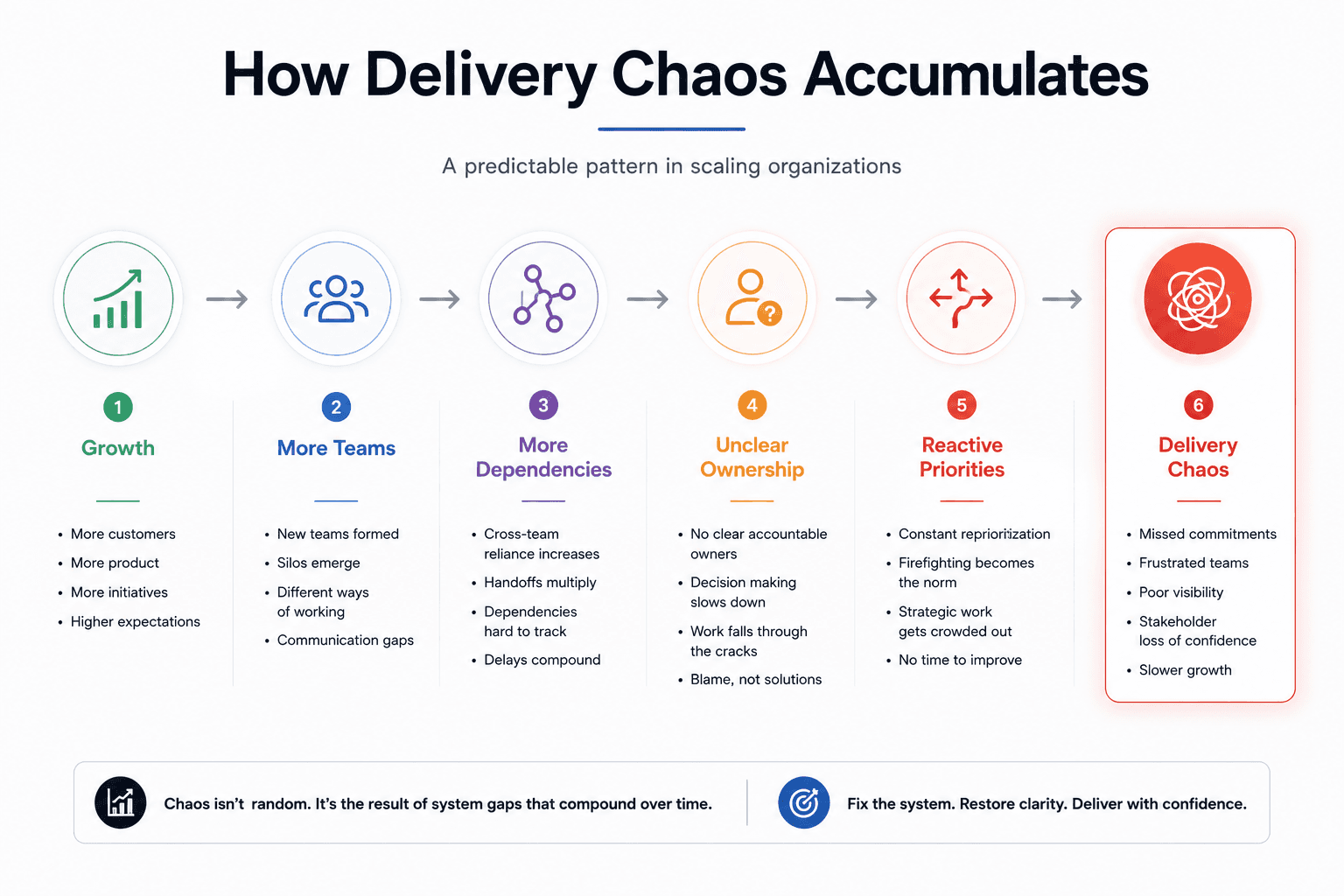
Operational chaos rarely appears overnight.
It begins gradually:
different teams interpret priorities differently;
ownership becomes unclear;
decisions stop being documented;
reporting becomes inconsistent;
leadership visibility weakens;
execution starts depending on specific individuals.
At first, growth hides these problems. Revenue increases. Teams stay busy. Product development continues.
But internally, delivery predictability slowly deteriorates.
Then eventually:
deadlines become unreliable;
roadmaps constantly shift;
teams lose alignment;
technical leaders burn out;
founders spend most of their time resolving operational confusion.
This is the point where companies start describing delivery as “chaotic.”
Why More Developers Usually Do Not Fix the Problem
One of the most common scaling mistakes is trying to solve operational complexity purely through hiring.
More engineers added into unclear systems often create:
more dependencies;
more communication overhead;
more prioritization conflicts;
more inconsistent execution patterns.
Without delivery structure, growth amplifies chaos.
Strong delivery organizations are not simply “high-talent teams.” They are coordinated systems with clear operational mechanics.
Common Symptoms of Structural Delivery Problems
In delivery audits, several patterns appear repeatedly across growing startups.
1- Founders Become the Main Coordination Layer
Every important decision flows through leadership. Teams wait for clarification constantly.
This creates bottlenecks and slows execution.
2- Team Leads Operate in Continuous Firefighting Mode
Leads spend most of their time handling escalations, priority conflicts, and delivery confusion instead of strategic execution.
Over time, this becomes unsustainable.
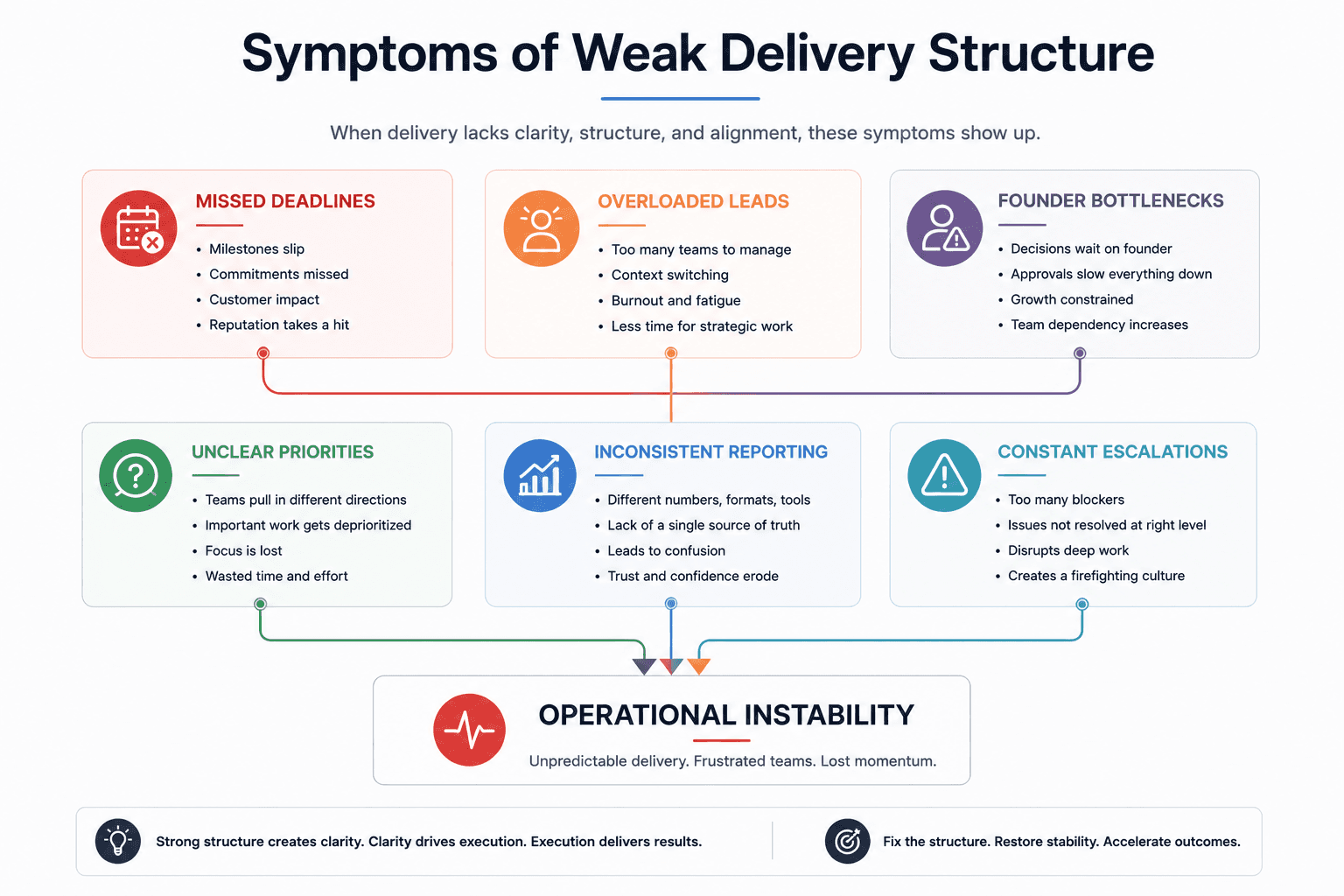
3- Reporting Exists But Visibility Does Not
Dashboards may exist, but leadership still cannot confidently answer:
what is delayed;
what is blocked;
what changed;
what threatens delivery.
This is usually a governance issue, not a tooling issue.
4- Teams Work Hard But Progress Feels Slower
One of the strongest indicators of operational misalignment is high activity with weak momentum.
The organization becomes busy instead of effective.
What Actually Stabilizes Delivery
Contrary to common assumptions, fixing delivery chaos does not require heavy enterprise bureaucracy.
In most startups, relatively lightweight operational structure creates major improvements.
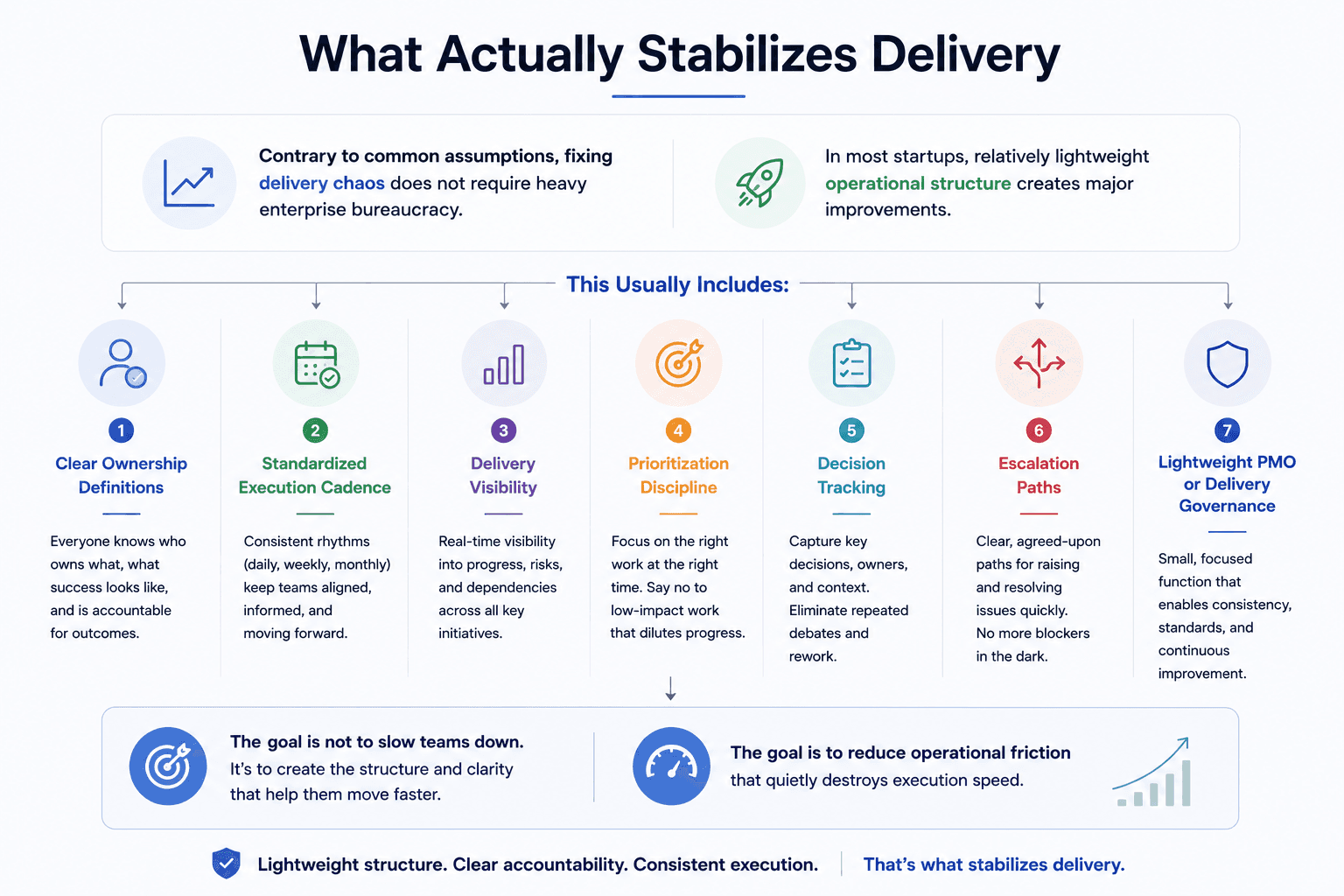
This usually includes:
clear ownership definitions;
standardized execution cadence;
delivery visibility;
prioritization discipline;
decision tracking;
escalation paths;
lightweight PMO or delivery governance.
The goal is not to slow teams down.
The goal is to reduce operational friction that quietly destroys execution speed.
Lightweight PMO Structure Is Often the Missing Layer
Many founders associate PMOs with corporate bureaucracy, excessive reporting, and slow processes.
Modern delivery governance should do the opposite.
A well-designed lightweight PMO helps:
increase execution predictability;
improve leadership visibility;
reduce dependency on founders;
standardize delivery practices;
improve coordination across teams;
create scalable operating rhythm.
The best delivery structures are usually almost invisible operationally but extremely powerful strategically.
Key Takeaways
Delivery chaos is usually a structural problem, not a developer performance problem.
Hiring more people into unclear systems often increases complexity.
Founders becoming operational bottlenecks is an early warning sign.
Teams can stay busy while organizational alignment deteriorates underneath.
Lightweight PMO and delivery governance can dramatically improve execution predictability without creating bureaucracy.
Delivery chaos is rarely caused by lack of effort. More often, it is the result of operational structure failing to scale alongside company growth.
At Miros we help software and AI companies stabilize delivery operations, improve execution visibility, and implement lightweight PMO structures that increase predictability without slowing teams down.

Insights
Read more articles



Questions & answers
Frequently
Asked Questions
We already have PMs. Why would we need this?
Most companies we work with already have PMs. The issue is not the people - it’s the system they operate in. Without a clear delivery structure: - PMs work differently - priorities shift constantly - decisions are unclear - delivery becomes inconsistent What we implement is a single operating model: - how projects start & planned - how they are executed - how they are tracked - how decisions are made Your PMs don’t get replaced - they become effective inside a system that works.